
Nvidia, Rebellions and SK Telecom announce a sovereign AI collaboration on NVLink Fusion
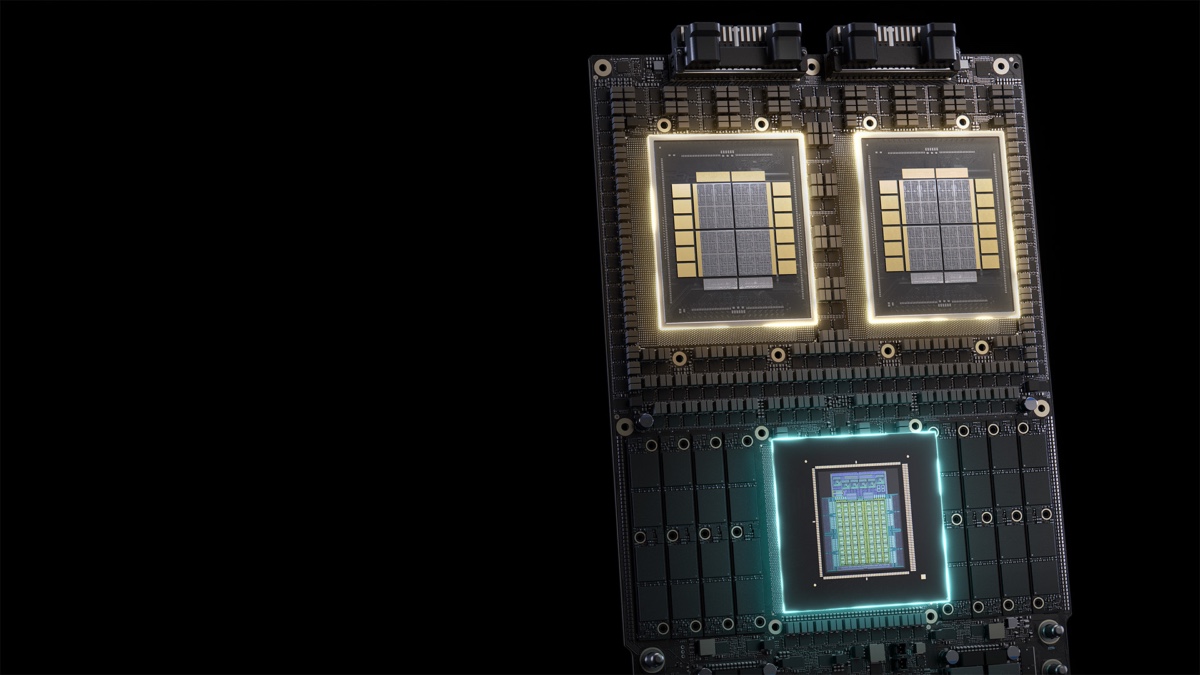
A trilateral MOU would pair Nvidia GPUs with Rebellions NPUs for Korea’s sovereign inference
In sum – what to know:
- Trilateral MOU – Nvidia, Rebellions and SK Telecom will pair NVIDIA GPUs with Rebellions NPUs for Korean sovereign inference, backed by the Ministry of Science and ICT.
- Undisclosed R200 details – The companies have published no R200 specifications, financial terms or order volumes.
- Rebellions’ track record – Its ATOM-Max deployments are real, but the performance figures come from its own tests.
Nvidia, Rebellions and SK Telecom have signed a memorandum of understanding to develop and validate an AI inference system for South Korea’s sovereign AI infrastructure. The system would pair Nvidia graphics processing units with Rebellions’ NPUs, and it’ll be built around Nvidia’s NVLink Fusion interconnect and MGX rack architecture — and it has backing from Korea’s Ministry of Science and ICT.
The companies expect systems based on Rebellions’ next-generation Rebel R200 NPU to be ready for deployment in 2028. Beyond that target, the companies disclosed remarkably little — no financial terms, investment commitments, order volumes, prices or detailed R200 specifications. This is an MOU, not a purchase order, but it still signals a direction for Korea’s sovereign inference infrastructure, and one that puts Nvidia hardware at the centre of a program intended to strengthen domestic chips.
The signing took place at Nvidia AI Day Seoul 2026, but Korean coverage was overshadowed by the scandal surrounding Jensen Huang. Nvidia’s board had announced an independent investigation a day earlier into what it described as a foreign intelligence effort targeting him, and Huang had acknowledged an extramarital relationship with a businesswoman that The New York Times reported US intelligence suspects of links to Chinese intelligence. The board said it had no reason to believe national security or Nvidia secrets had been compromised — and it retained confidence in Huang’s leadership.
Who does what in the three-way deal
Formally, this is a trilateral MOU. Rebellions will connect its Rebel R200 NPUs to Nvidia’s platform through NVLink Fusion and build rack-scale systems using the MGX architecture. SK Telecom will deploy those systems in its AI data centres, validate their performance and stability, and connect them to its A.X K2 foundation model and public services developed under the government’s “AI for All” project.
Nvidia supplies much of the surrounding infrastructure, including the NVLink interconnect, switching, rack design and broader software and hardware ecosystem. MGX gives Rebellions a standardised rack footprint, power delivery and cooling design, along with access to an established manufacturing and component supply chain. Building a competitive NPU is difficult enough. Building everything around it? That’s another problem entirely.
MSIT is providing policy sponsorship rather than a disclosed hardware order. It describes Rebellions and SK Telecom as the starting point of a planned series of collaborations with Nvidia, covering research, pilot verification, commercialisation and exports. The ministry is also keeping another architecture in play, having signed a separate MOU with AMD in July 2026 covering an open AI infrastructure ecosystem and links with domestic NPUs.
“Korea has the talent, technology and industrial ambition to become a world leader in AI,” Huang said in the announcement. Rebellions CEO Sunghyun Park was more direct about the compromises involved. “An approach that seeks to localize 100% of everything, from bolts and screws to operating systems, is unrealistic in terms of scalability and time to market,” he said.
That’s a reasonable engineering argument, but it also concedes how much of the sovereign stack would remain Nvidia’s.
How GPUs and NPUs would split inference
NVLink Fusion, unveiled at Computex in May 2025, extends Nvidia’s proprietary NVLink interconnect beyond GPU-to-GPU connections. It allows third-party processors to join the same high-speed domain — CPUs, NPUs and other application-specific chips that Nvidia collectively calls XPUs. The approach opens Nvidia’s rack architecture to outside silicon, but it keeps the interconnect itself firmly under Nvidia’s control.
The planned systems would divide inference into two stages. Nvidia GPUs would handle prefill, which processes the incoming prompt and requires substantial raw compute, while Rebellions NPUs would take over decode, which generates the response one token at a time and depends more heavily on memory bandwidth and latency. The companies say this arrangement should improve throughput and power efficiency, but they haven’t provided performance figures to support either claim.
Splitting prefill and decode is already established practice across pools of GPUs, including systems managed through Nvidia’s Dynamo serving software. The new element is dividing those stages between different processor architectures inside one rack, and that makes the handoff between them especially important.
During prefill, a model creates a KV cache, essentially its working memory of the prompt. That data must move from Nvidia GPU memory to Rebellions NPU memory before the first output token can be generated, yet the companies haven’t explained the transfer mechanism, its latency or its bandwidth. Nor have they said whether the R200 will support Dynamo or NIXL, the open-source transfer library Nvidia uses to move data, including KV-cache data, between GPU, CPU and storage memory. For large models and long prompts, this handoff could determine whether the theoretical efficiency gains survive contact with a production workload.
Nvidia claims NVLink 6 can connect 72 XPUs at 3.6TB/s per processor and deliver three times lower latency than off-the-shelf Ethernet. Those are vendor figures, and there aren’t any independent results yet for the planned GPU-NPU configuration.
The R200 itself remains mostly a description rather than a published specification. Rebellions says it’s being designed for low-latency, energy-efficient inference on frontier models, including multitrillion-parameter mixture-of-experts models that activate only parts of their networks for each token. Memory capacity, process node, power consumption, bandwidth and benchmark results are all undisclosed.
Rebellions’ Rebel100 offers the nearest available proxy. It combines 144GB of HBM3E high-bandwidth memory with 4.8TB/s of memory bandwidth and up to 1PFLOPS of FP16 compute, equivalent to one quadrillion 16-bit floating-point operations per second. Its maximum power draw is around 600W, compared with up to 700W for Nvidia’s H200 SXM, which puts the two in a broadly comparable power class, but those figures don’t establish how the R200 will perform.
Memory capacity may prove a bigger constraint than compute. SK Telecom’s A.X K2 has 688 billion total parameters, with 33 billion active for each token. Its weights use FP8, an 8-bit numerical format that reduces memory requirements, but still occupy roughly 695GB. That would require at least five Rebel100-class packages, providing 720GB combined, before accounting for the KV cache or other working data. Fitting the model across enough packages is one challenge, and moving data between them efficiently is another.
Rebellions will also arrive after other decode specialists already attached to Nvidia’s platform. Nvidia’s Groq 3 LPX uses fast on-chip SRAM memory and is in production, while d-Matrix’s Raptor uses stacked 3D-DRAM and is targeted to reach MGX racks in the fourth quarter of 2027. The R200 would add an HBM-based alternative in 2028, after both have had time to build installed bases.
One naming detail is worth keeping straight. Rebellions’ chip is the Rebel R200 NPU, while Nvidia’s Rubin GPU, with 288GB of HBM4 memory, is unofficially called the R200. They’re different processors, and coverage that shortens the Rebellions chip to “R200” doesn’t make that distinction especially easy to follow.
Rebellions’ track record and the sovereignty trade-off
Rebellions does have production deployments behind it, and its ATOM-Max NPUs were running four commercial SK Telecom services as of September 2026. Those services cover call summarisation, streaming text-to-speech, an AI contact centre and the Scam Vanguard fraud-detection service. Rebellions says they handled around 14 million requests and more than 4 billion tokens per day across a farm of hundreds of cards operating alongside GPUs.
The company claims ATOM-Max delivers roughly 3.3 times the token throughput per watt of Nvidia’s L40S and about half the initial server deployment cost. Those results come from Rebellions’ internal tests using Llama 3 70B — not independent benchmarking. Public benchmark data for its newer Rebel100 is also thin, and the efficiency case for the R200 isn’t much more than theory yet.
Its disclosed production base is concentrated in Korean telecom groups that are also shareholders, including SK Telecom and KT, though it also includes public-sector deployments. Those are useful reference customers, but they’re weaker evidence of open-market demand than deployments for unrelated buyers. Rebellions has announced further rack projects in Japan and with a UK government-backed research cluster — although those don’t yet establish sustained commercial volume.
Founded in 2020, Rebellions merged with SK Telecom’s AI chip unit Sapeon in December 2024. A $400 million pre-IPO round in March 2026 valued it at approximately $2.34 billion, and it’s targeting a Korean listing in the first half of 2027. The Korea National Growth Fund’s KRW250 billion contribution, around $166 million, was an equity investment rather than an order for chips.
Government procurement has sent a more mixed signal. The National AI Computing Center went to a Samsung SDS-led consortium centred on GPUs after a rewritten tender removed a requirement for domestic NPUs to supply as much as half of its chip mix by 2030. Korea can subsidise domestic silicon without necessarily buying it at scale, which is the gap the R200 will need to close.
The sovereignty question runs deeper than one procurement. Counterpoint Research estimates that Nvidia GPUs appear in about 92% of the sovereign AI models it analysed, for training or inference, and Korea’s own national-model programme has increased its Nvidia GPU allocations. NVLink Fusion arguably remains only semi-open — NVLink is proprietary, every node still requires Nvidia silicon, and Nvidia GPUs keep the prefill work while Korean NPUs are assigned decode.
FuriosaAI is taking a different route. Korea’s other leading NPU startup, valued at $2.9 billion after its October Series D round, has put its RNGD chip into mass production and is developing a third-generation chip with Broadcom that uses Ethernet networking, an approach also favoured by AMD and Intel. Korea’s two leading NPU startups are therefore taking different interconnect routes rather than converging on a common domestic standard.
The Huang affair added an unwelcome distraction to the Seoul event, and Madison Huang, his eldest daughter and an Nvidia senior director, cancelled her Korea visit, including a planned trip to Rebellions’ headquarters and dinner with its executives. According to The Elec, Nvidia vice president Ashish Karandikar attended the NVLink Fusion signing in her place. Nvidia shares closed down about 4% on Monday and fell further on Tuesday, with the company’s fiscal third-quarter (Q3 FY2027) results due on November 17.
The immediate test for the collaboration is more technical than financial. Rebellions still needs to publish credible R200 specifications and power figures, SK Telecom has yet to commit to a named rack count or capacity, and neither company has demonstrated the KV-cache handoff at A.X K2’s scale. Until those details arrive, Korea has settled on one architecture for this program without proving that it pays for itself or establishing how much independence it actually provides.
Table of Contents
Comments are closed.