
Verizon completes Thames Freeport private 5G deployment – as ECE moves back in focus
Verizon has completed a five-site private 5G deployment across Thames Freeport – almost 18 months after the deal was first announced. The project spans ports, logistics, and manufacturing, and features a broad pipeline of industrial applications.
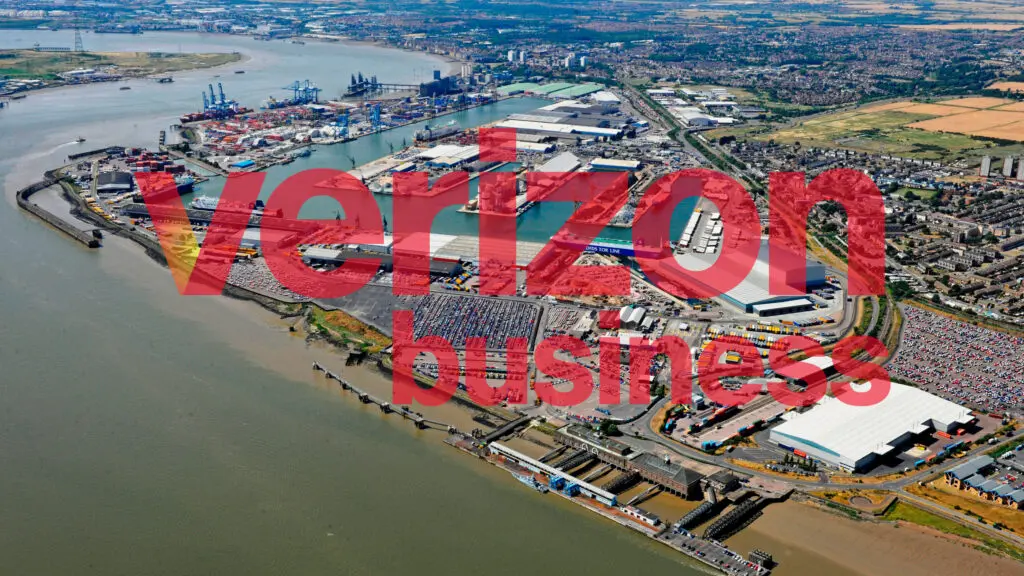
Major deployment – the project covers five sites across DP World London Gateway, DP World Logistics Park, Ford Dagenham, and the Port of Tilbury, as one of Europe’s highest-profile carrier-led private 5G deployments.
Beyond networks – applications already trialled include AI vehicle-damage detection, digital truck processing, and mission-critical field comms. Further scope includes digital twins, predictive maintenance, autonomous operations.
Nokia transition – the project is another notable public reference for Nokia’s ECE business, and a first official outing since a PR embargo following announcement of its planned sale, now agreed with private equity firm Aurelius.
Verizon has completed its multi-site private 5G deployment across Thames Freeport in southeast England, first announced in June 2025, delivering industrial connectivity across five locations spanning ports, logistics, and manufacturing. The project is one of Europe’s highest-profile carrier-led private 5G deployments, not just for its geographical reach but for the breadth of industrial applications being explored. It brings together port operations, vehicle movements, worker safety, asset management and AI-based analysis across a major industrial and logistics district.
The network covers DP World London Gateway and DP World Logistics Park, Ford’s Dagenham site, and two locations at the Port of Tilbury. Each tenant network operates on an independent network core, providing data sovereignty for the organisations using the infrastructure. Nokia has supplied the hardware and software, including its Digital Automation Cloud (DAC) private wireless platform and MX Industrial Edge (MXIE) computing platform. These are from its Enterprise Campus Edge (ECE) business, which has built much of the ‘campus’ 5G market, and was put up for sale by its parent 18 months ago.
Last month, Nokia agreed to sell its ECE unit to private equity firm Aurelius; the sale is expected to complete in the first half of 2027. The new announcement by Verizon is the first public outing, effectively, for ECE since a PR embargo was imposed with the sale announcement late last year.
Nokia has also supplied the radio equipment, via its ‘mobile infrastructure’ division – which mostly sells 5G equipment to big telcos.
The timing is worth noting. Verizon and Nokia were named as ‘prime’ suppliers for the Thames Freeport project 17 months ago, mid-2025; the delay might not be attributed just to the ECE sale process, but also to some reorganization within Verizon Business, plus also the scale and ambition of the project – including coordination and complexity to deliver private 5G across multiple different industrial sites with different operators, tenants, applications, and operational requirements
Industrial 5G operations
The network is intended to support considerably more than just basic wireless coverage for workers. The stated pipeline includes real-time physical AI, computer vision, asset tracking, predictive maintenance, edge computing, plus worker safety. There is a longer-term ambition to support increasingly autonomous AI-enabled operations across the site.
Some applications have already moved into trials. These include an AI-based detection system to identify damage missed during manual vehicle inspections; digital truck processing to connect terminals, depots, and drivers, and provide greater visibility of vehicle movements and queues; and mission-critical field comms combining push-to-talk, video, location information, and emergency alerts.
A digital map of the container yard is also in development. Other applications under review include digital twins and simulation, AI-supported estate monitoring using video and drones, natural-language processing tools for operational decision-making, predictive maintenance, and environmental monitoring.
The breadth of use cases is striking – and starts to look like a potential template for physical AI in microcoms, also underlining the vision for private 5G as part of new AI-supported mobile OT systems. The project brings together port operations, vehicle movements, worker safety, asset management, and AI-based analysis across a geographically dispersed industrial estate.
It is a way more expansive proposition than the familiar private 5G pitch around connecting machinery or replacing Wi-Fi in a factory. But there is a distinction, as well, between a use-case pipeline and a proven operational return. The announcement describes a mixture of completed trials, works in progress, and applications still being investigated. The test will be whether these experiments translate into repeatable deployments, measurable productivity gains, and a compelling business case for the port’s tenants.
Industrial 5G statement
The project was originally presented as a significant contract win for Verizon Business in the UK private networks market. The 2025 announcement covered three industrial locations – London Gateway, Tilbury and Ford Dagenham – across roughly 1,700 acres, with around 80 private 5G radio units planned. The original design was based on 3.8-4.2GHz spectrum and a 5G-only network, rather than a hybrid of 5G, Wi-Fi ,and other wireless tech.
It was a notable competitive win for Verizon in a market where established UK mobile operators might otherwise be expected to have the advantage. The project also extended a relationship between Verizon and Nokia that began with Verizon’s earlier European private networks contract at Associated British Ports in Southampton.
The latest announcement describes five sites, with independent cores for each tenant network. The original figures of around 80 radios and 1,700 acres provide a sense of the intended scale, although the companies have not supplied an updated radio count or a detailed breakdown of the final network configuration.
For Verizon, the completed deployment gives it a substantial multi-site European reference as it competes for industrial connectivity business. It also offers a platform to demonstrate how private 5G can support operational applications beyond conventional enterprise connectivity.
For Nokia, the project is a timely showcase for ECE as the business prepares to leave the group. The sale to Aurelius is intended to give the division greater independence and a dedicated strategic focus, but the transaction remains subject to completion conditions.
Thames Freeport says it has attracted more than £2.13 billion in private investment since 2021, with the potential for a further £4.9 billion and up to 28,000 jobs by 2045. The private 5G network is positioned as part of the digital infrastructure supporting that longer-term industrial development.
Robb Juliano, vice president of the 5G ‘acceleration’ business within Verizon Business, stated: “The implementation at Thames Freeport is a perfect reference point for the versatility and scalability of private 5G across complex industrial sites: one commercial hub, five individual sites with unique needs, and a multitude of connected use cases. Together with Thames Freeport, we’re creating a digital foundation for automation, physical AI, and future industrial growth to revitalize an entire economic region.
“Similar enterprises hosting multiple sites with complex and evolving needs – especially as physical AI redefines industrial operations – can lay the same private 5G foundation from which to build their own transformations.”
Tom White, innovation and skills director at Thames Freeport, said: “This deployment gives our key sites a platform to innovate together while continuing to meet the realities of live industrial operations. It strengthens Thames Freeport’s ability to help businesses test, adopt and scale new technologies and helps us attract investment, accelerate innovation, and create high-value jobs.”
Comments are closed.