
Nvidia, post-Huang – who will underwrite the AI compute boom? (Analyst Angle)
Nvidia’s customer financing guarantees are under scrutiny following its leadership upheaval, raising questions about whether smaller AI cloud providers can secure funding for new GPUs. Any slowdown could shift compute capacity towards hyperscalers and longer-term customers.
Nvidia helps some of its customers borrow the money they need to buy its GPUs. Its guarantees give lenders a stronger company to rely on when a young cloud provider cannot secure financing on its own. If Nvidia becomes less willing to sign those guarantees, smaller AI companies could find it harder to rent the newest chips on short contracts. More of the new capacity would be financed around large customers that can commit for several years.
Nvidia announced on November 12 that Jensen Huang had resigned as president, chief executive and a director. Chief financial officer Colette Kress is now interim CEO. Bloomberg reported on November 8 that Nvidia’s board had opened an independent investigation after Huang disclosed an affair and reports alleged that the woman involved had links to Chinese intelligence. Nvidia’s board said it had no reason to believe company secrets or national security had been compromised. The allegations remain unresolved. Their relevance to compute financing is whether directors delay new commitments while they examine relationships with cloud partners. [1, 2, 29]

Nvidia’s board says customer commitments should continue without interruption. Nvidia has not announced a freeze on new guarantees. I expect closer scrutiny and slower approvals while the investigation is open, with the greatest risk to deals that have financing deadlines. Its ability to honour existing promises is a separate question. A November 9 market commentary put Nvidia’s 2031 spread at 77.5 basis points over Treasuries on November 9, less than two basis points wider than a week earlier. If that comparison is accurate, bond investors had made little change to their assessment of Nvidia’s ability to pay. [11, 29]
The buyers most exposed would be startups, smaller labs and other organisations renting recent GPUs from independent clouds for a year at a time. I use AI commons to describe that broadly available rental capacity. Google and Broadcom can also support data centre financing, but the large transactions discussed here are tied to particular chips and tenants. Their guarantees would not necessarily replace the capacity available to a small buyer choosing its next training run.
Nvidia’s cited filing for the quarter ended July 26, 2026 reports $108.5 billion of guarantees. Adding $36 billion of cloud capacity agreements and $20 billion of leases for others produces $164.5 billion of commitments, about 72% of the reported $229 billion of shareholder equity. These obligations have different payment triggers and dates. Their combined face value shows the scale of Nvidia’s support, but does not measure the loss it expects to incur. [3, 4]
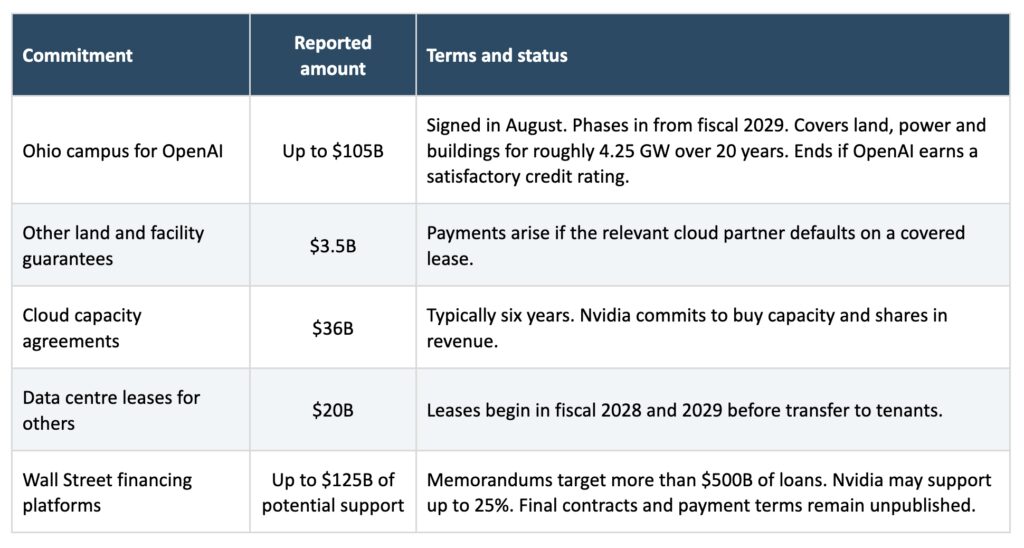
The proposed $125 billion of support for the Wall Street platforms should remain separate from signed commitments. Adding it to $164.5 billion produces $289.5 billion, which helps explain headlines near $300 billion, but treats a prospective programme as though it were already binding. Nvidia also reported $99 billion of equity holdings and $25 billion of additional equity commitments. Those investments belong in an assessment of customer exposure, with care to avoid counting the same transaction twice. [3, 5, 6]
Nvidia reported $56.6 billion of cash and marketable securities, alongside $63.1 billion of receivables. The reported collection period rose from 45 to 60 days as Nvidia gave investment-grade customers longer to pay. Payment terms are another way to finance customers, so a change in guarantees could be partly offset by a change in how quickly Nvidia collects its invoices. [3, 4]
A lender needs a credible source of repayment. A cloud provider with a three to six year contract from an investment-grade customer can borrow against that contract. A guarantee from a stronger company can serve a similar purpose. This helps explain why Moody’s could rate a CoreWeave facility A3 while S&P rated the company itself B+. The facility and the unsecured company debt expose creditors to different risks. [7, 9, 10]
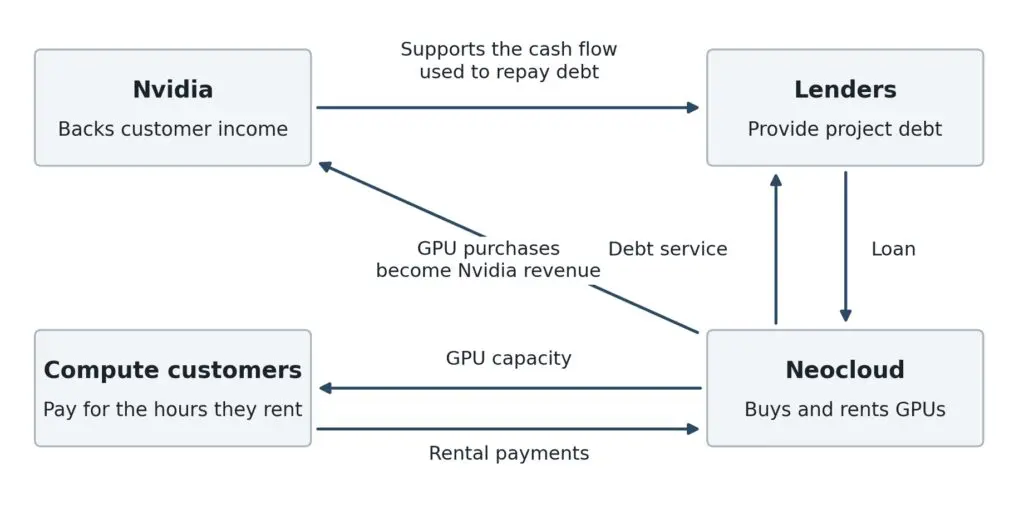
The difficulty for a new cloud provider is getting each party to commit. It needs equity for GPU deposits, investors want evidence of customers and bank funding, and customers want confidence that the GPUs will arrive. SemiAnalysis describes Nvidia arrangements that promise a minimum rental income for roughly six years in return for a share of revenue above that floor. The provider can then rent to a range of customers while lenders rely partly on Nvidia’s commitment. [7]
The reported SharonAI arrangement illustrates the scale. A $4.88 billion commitment spread across 40,000 GB300 GPUs for six years is about $2.32 per GPU per calendar hour. I use $2.33 in the financing example below. That conversion alone does not establish what Nvidia pays in any particular hour. Availability requirements, operating costs and payment triggers depend on the contract. [7]
To show how financing affects price, I assume an installed GPU costs $68,000, earns revenue during 85% of the year and has a six-year economic life with no residual value. Operating costs are $0.40 per rented hour. The calculation recovers the capital over six years at the assumed debt rate and equity return. It excludes taxes, transaction fees and any additional working capital. The assumed financing rates draw on the neocloud analyses cited here. [7, 8]
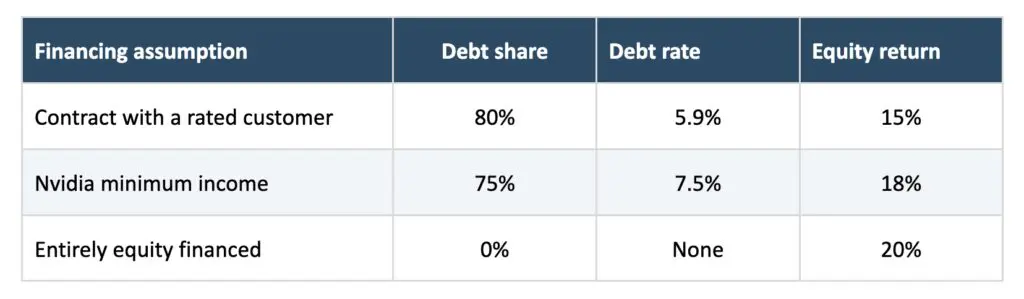
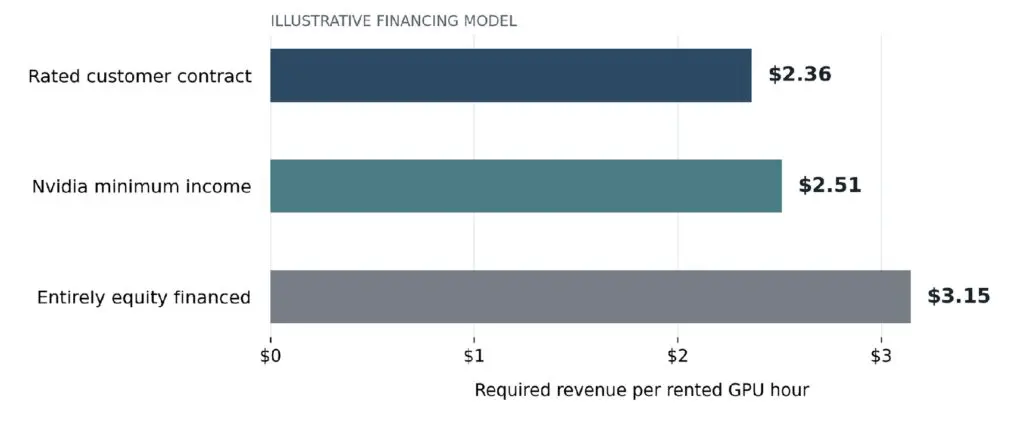
In this example, removing debt raises the required rental price from $2.51 to $3.15 per GPU hour, about 25%. It also quadruples the equity needed for the same purchase. A $68,000 GPU requires $17,000 of equity at 75% debt financing and $68,000 when funded entirely with equity. A guarantee can therefore affect both the price of compute and the amount a provider can afford to install.
The loan calculation also depends on which hours receive the minimum payment. At a $2.33 minimum, subtracting $0.40 of operating cost leaves $1.93 per eligible hour. If lenders require cash available for debt service to equal 1.3 times the payment, about $1.48 per eligible hour can go to debt service. Over six years at 7.5%, that supports roughly $61,000 of debt if the calculation uses all 8,760 hours of the year. Using only 85% of those hours reduces the loan to about $51,900, close to the $51,000 implied by the assumed 75% debt share.
A $2.33 payment for every calendar hour would equal about $2.74 per rented hour at 85% utilisation, before adjusting for contractual conditions and costs. A $2.33 payment only for rented hours would fall below the modelled $2.51 rental price needed to earn the assumed equity return. The contract is needed to decide which comparison applies. The headline backstop value cannot establish the provider’s profitability.
Nvidia had reportedly reduced or paused support before the investigation. Reuters reported that an Ohio proposal discussed at roughly $250 billion was reduced below $120 billion before Nvidia signed for $105 billion. Its shares fell about 5% after the initial reports. On August 27, the Wall Street Journal reported a pause in parts of the AI Compute Partnership after staff raised antitrust concerns. [14, 15]
Nvidia cut the Ohio proposal after its shares fell, but the available evidence does not show how much that decline influenced the decision. Negotiations over the terms, legal concerns and expected demand may also have mattered. The November investigation gives directors a further reason to examine new guarantees closely.
The immediate risk is a delay long enough to disrupt a customer’s financing. Directors reviewing relationships with cloud partners may ask for more evidence before approving another commitment. Existing guarantees can remain in force while new ones take longer or cover less. My expectation is that deals involving the relationships under review face the greatest delay. A blanket pause through the end of the investigation is a possible outcome, rather than an announced policy.
Other financing routes were already becoming harder. CNBC reported that Microsoft was consolidating its neocloud suppliers. Other reports said it let an Oracle capacity contract lapse as the chips aged and declined an option on about 700 MW at Nscale’s Texas site. CoreWeave’s five-year credit default swap spread reportedly reached 1,289 basis points on November 5, and its chief executive said the company would not borrow unsecured at prevailing yields. [12, 13, 16, 17]
The reported November 9 bond spreads were about 77.5 basis points for Nvidia and 1,087 for CoreWeave. The comparison needs matching maturities and spread definitions before it can be treated as precise, but it illustrates the difference between the two borrowers’ funding costs. If Nvidia retains that credit advantage, directors would still have a financial reason to support selected customers once they are satisfied with the risks. [11]
The risk to each project depends on whether its agreements are binding and what happens if financing arrives late. Nscale’s reported Anthropic contract for its West Virginia campus allows cancellation if Nscale misses those deadlines, so a slower guarantee decision could jeopardise a customer agreement even without an outright refusal. [19, 20]
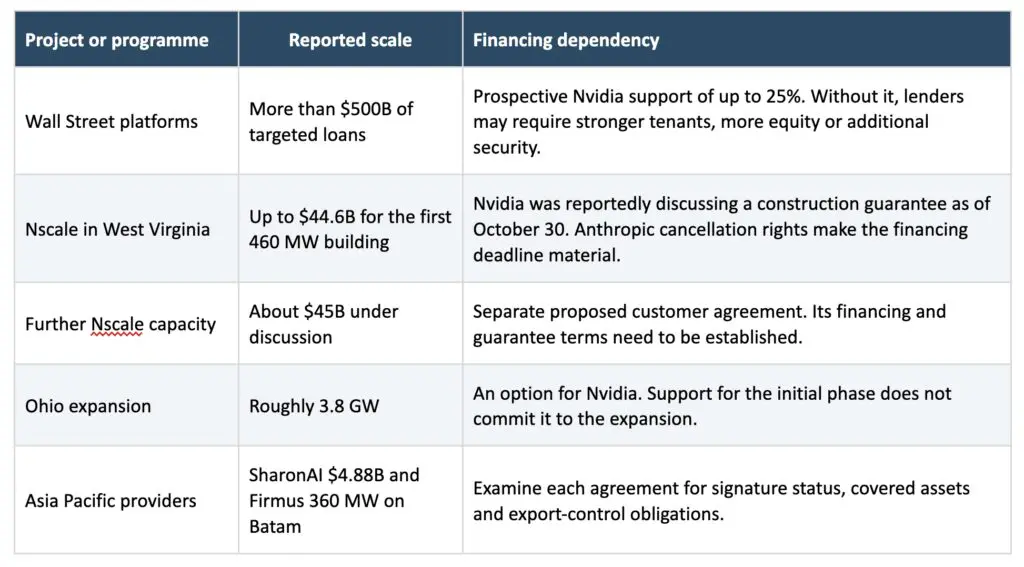
The platforms’ proposed ratio of $500 billion of loans to $125 billion of Nvidia support is four to one. That is a ratio of lending to contingent support. It is different from the fourfold increase in a provider’s equity requirement when 75% debt financing disappears. The eventual contracts would determine which losses Nvidia covers and how much protection lenders receive. [5, 6]
Asia Pacific transactions may face closer checks following allegations involving Megaspeed, a Singapore cloud provider. Firmus’s reported Batam project is in Indonesia, near Singapore. Geography alone says nothing about a provider’s conduct. The financing issue is whether lenders demand stronger evidence of where GPUs are installed, who controls access and how compliance is monitored. Any requirements under the proposed Chip Security Act would depend on the legislation ultimately enacted. [7, 10, 21, 22]
Google and Broadcom already provide alternatives for some large projects. Reports describe roughly $35 billion of Google support for Anthropic data centres, with up to $44 billion of further lease support across about ten projects totalling 2.4 GW. Broadcom reportedly guarantees around $31 billion of debt for Anthropic’s TPU expansion, helping the debt obtain an investment-grade rating and a borrowing rate near 5.75%. On the Nexus project in Texas, Google reportedly receives about 20% of the data centre and power assets in exchange for its guarantee. These totals may overlap, so I do not add them into a single financing figure. [23, 24, 25, 26]
These arrangements can finance large amounts of compute while tying a project to a particular tenant and accelerator. The Anthropic projects discussed here use Google TPUs. Nvidia also has commercial interests in the customers it supports, including equity stakes in major labs. Its broader interest is selling GPUs to many buyers, and the neocloud arrangements described by SemiAnalysis allow providers to rent to different labs. Google sells its own models through Gemini and owns part of Anthropic. The consequences for a small renter depend on how much capacity each agreement leaves available to other customers. [3, 7, 25]
Customers can also fund construction through deposits and prepayments. CoreWeave said it expected $9 billion of such payments over the following three months. For the largest labs, a stronger credit rating could reduce the need for a third-party guarantee. Semafor reported that OpenAI and Anthropic were seeking investment-grade ratings ahead of potential listings. Nvidia’s Ohio arrangement reportedly permits its guarantee to end once OpenAI obtains a satisfactory rating. [3, 13, 27]
An investment-grade rating would improve a lab’s ability to borrow, though individual projects could still require guarantees or other security. If the largest labs secure credit on their own, the remaining applicants for vendor support are likely to include a greater share of smaller and riskier borrowers. If the large labs continue to need guarantees, the chip suppliers and cloud companies providing them will have more influence over which systems get built.
Smaller buyers would still have options. They could rent older GPUs, buy compute from hyperscalers or obtain capacity from independent providers with strong long-term tenants. The concern is the quantity and price of recent GPUs available on shorter contracts. A data centre financed around one large tenant may contribute little to that market, even as total installed capacity rises.
The cited fiscal Q2 FY27 commentary attributes $40.3 billion of $89.0 billion of data centre revenue, about 45%, to AI clouds, industrial and enterprise customers outside the hyperscaler category. That category is much broader than the AI commons and includes customers with their own financing. The share of revenue dependent on guarantees would be smaller and cannot be inferred from that breakdown. [4]
Strong customer contracts remain an important alternative explanation for successful GPU financing. Lambda’s cited $1 billion loan carried a 6.78% rate and a Baa1 rating, backed by contracts with two investment-grade customers. Moody’s also based its A3 assessment of a CoreWeave facility on customer contracts. Those examples show that independent clouds can raise debt without depending solely on a vendor’s promise. A comparable facility financed on attractive terms without either a rated customer or a vendor guarantee would weaken the argument that this support is essential. [7, 9, 10]
The next Nvidia results call is listed for November 17. Its quarter ended October 25, before the reported investigation, so the quarterly balance sheet cannot show the investigation’s effects. The useful evidence will be agreements signed after November 8, subsequent-event disclosures and management’s explanation of approval policy. A guarantee signed in August or October would tell us little about November’s decisions. [28]
A material new guarantee signed while the investigation remains open would contradict a forecast of a complete freeze. It could still be consistent with more selective approvals. Final agreements for the Wall Street platforms, the size and terms of Nvidia’s support, and a restart of the partnership programme would provide better evidence of how much credit remains available. Nvidia could also support customers by giving them longer to pay, so changes in receivables and payment terms could reveal additional financing.
Over the next six to nine months, I expect financing to favour providers with rated tenants and firm commitments over those relying on short rentals. Nscale’s West Virginia project offers a concrete test. It could secure the proposed Nvidia guarantee, accept narrower support, find another guarantor or reduce the project. A shift of the workload to TPUs would require further decisions by Anthropic and its suppliers. It does not follow automatically from a delay at Nvidia.
A transaction record would help test the broader argument. For each guarantee, I would record the provider, tenant and chip, along with the term, cap, payment trigger and signing date. I would track both the share of new financing backed by companies that sell no AI models and the share of capacity available to unaffiliated renters. The first measures who supplies credit. The second is closer to the access the AI commons is meant to describe.
Rental prices could provide another signal. Where reliable data are available, I would compare one-year contracts for Rubin with H100 and H200 contracts of similar size, location and service level. Firm prices for new chips alongside falling prices for older chips would be consistent with a shortage of accessible new capacity. Product launches, changes in demand and power constraints could produce the same pattern, so prices need to be read alongside the financing record.
The practical consequence for a compute exchange or price index is to keep these markets distinct. A one-year rental of the latest GPU and a multiyear commitment from a rated customer have different financing requirements and different buyers. If more new capacity is reserved for large tenants, an aggregate GPU price can fall as older chips get cheaper while a small lab pays more for the hardware it needs.
References are numbered in order of topic. Figures use the assumptions stated in the text.
[1] Nvidia board statement
[2] Bloomberg reporting on the board investigation
[3] Nvidia fiscal Q2 FY27 Form 10 Q
[4] Nvidia fiscal Q2 FY27 CFO commentary
[5] CNBC reporting on the proposed Wall Street financing platforms
[6] Reuters reporting on the proposed 25% backstop via Yahoo Finance
[7] SemiAnalysis on Nvidia GPU debt backstops
[8] Acquinox on the neocloud financing balance sheet test
[9] AM Compute on the state of neoclouds in 2026
[10] Collyer Bridge on neocloud financing in Southeast Asia
[11] Moomoo community post comparing Nvidia and CoreWeave bond spreads
[12] Quartz reporting on CoreWeave credit stress
[13] 24/7 Wall St reporting on CoreWeave results and funding
[14] Reuters reporting on the reduction in the Ohio guarantee via Yahoo Finance
[15] Reuters reporting on paused revenue sharing agreements via Yahoo Finance
[16] CNBC reporting on Microsoft consolidating neocloud suppliers
[17] MLQ reporting on Microsoft capacity decisions
[18] Options Trading Report on AI financing conditions
[19] TechCrunch reporting on the proposed Nscale guarantee
[20] Nscale registration statement
[21] Israel Hayom reporting on allegations involving Megaspeed
[22] Carra Globe discussion of the Chip Security Act
[23] Business Standard reporting on Google support for Anthropic
[24] Crypto Briefing reporting on further Google lease support
[25] Capacity reporting on Broadcom guarantees for TPU financing
[26] Global Data Center Hub on the Nexus project
[27] Semafor reporting on OpenAI and Anthropic credit ratings
[28] Nvidia third quarter results call announcement
[29] Nvidia CEO transition announcement of November 12 2026
Comments are closed.