
What will an AI crash look like? (Analyst Angle)
The AI infrastructure boom could end in a crash resembling telecoms’ late-1990s fibre bust, leaving investors nursing huge losses but potentially handing utilities and infrastructure funds cheap assets to power the next phase of growth.
In the last week of October 2026 the largest AI builders reported their quarterly results, and demand for AI looked stronger than ever. Google’s cloud revenue more than doubled from a year earlier, Amazon’s grew 39 percent and Microsoft’s 48 percent, and Intel’s data center sales rose almost 80 percent. Investors sold the stocks anyway. Alphabet and Amazon each lost about a tenth of their value in after-hours trading, Meta fell 7 percent and Intel more than 20 percent, while Microsoft rose.
The companies that fell are spending more on data centers and chips than their businesses bring in. Meta, Alphabet and Amazon all reported negative free cash flow, which is the cash left after paying for that spending, and Meta has started selling up to $95 billion of new stock to cover the gap. Further down the chain, CoreWeave, which rents out AI chips and carries about $50 billion of debt, has bonds paying investors more than 16 percent a year, a level lenders only demand when they doubt they will be repaid.
Most coverage reads the selling as proof that people want less AI than was promised. The results themselves show demand growing quickly, so I read the selling as a judgment on how the AI build-out is being paid for, which is a separate question from whether people want to use AI. When the companies that borrowed heavily can’t pay, their data centers will be sold to new owners at much lower prices. Those owners can sell AI far more cheaply, and that is how AI ends up being used the way we use electricity, cheaply and all day long.
Full rooms and a bankrupt owner
A hotel makes the idea easy to see. A developer builds a hotel in a busy tourist town for $10 million and borrows the whole amount at 12 percent interest. The town is full of visitors and the rooms are booked most nights. After paying staff and running costs, the hotel has $1 million a year left over. To keep the math simple, count only the interest on the loan, which is 12 percent of $10 million, or $1.2 million a year. The hotel brings in $1 million and owes $1.2 million, so the developer loses $200,000 a year and eventually goes bankrupt.
Nothing went wrong with demand. The visitors came and the rooms were full. The developer failed because he paid a lot for the building and borrowed expensive money to do it. The bank then sells the hotel to a new owner for $3 million, and she borrows at 7 percent. Her interest is $210,000 a year. She has the same building and the same guests, and she keeps about $790,000 of the $1 million.
AI is in the same position. Eight of the largest AI builders, including the big cloud companies and CoreWeave, are expected to spend about $971 billion on data centers and chips in 2026. OpenAI and Anthropic together are bringing in revenue at a rate of about $115 billion a year. That is roughly $8 spent for every $1 these two companies take in. The real gap is smaller, because the cloud companies also sell AI services of their own, but spending is still growing faster than revenue. A 16 percent bond yield is a market signal that the first owners may not survive even though visitors are still coming.
Two kinds of owner
Carlota Perez, an economist who has studied the major technology waves since the 1770s, gives names to the two hotel owners. The first owner is what she calls financial capital. He bought because he expected growth. Prices were rising and lenders were eager, so a high price seemed reasonable. The second owner is production capital. She makes her money from running the hotel night after night, and she needs the building to be cheap enough that ordinary business pays.
Perez finds that each technology wave goes through the same handoff between these two owners. In the first period, which she calls installation, financial capital builds the new infrastructure quickly, with a lot of borrowed money and a lot of optimism. That period ends in one or more crashes. She calls the crash and the years around it the turning point, because that is when the assets pass to the second kind of owner. In the period after, which she calls deployment, those owners run the assets cheaply and the benefits spread to ordinary customers. Perez adds that governments have to change the rules during the turning point, or the good outcome does not arrive.
She does not see AI as the start of a new wave. In her view it is the third stage of the digital revolution that began with the microprocessor in the 1970s and continued with the internet in the 1990s. That view changes the dates but leaves the handoff the same, and she still expects the same sequence. Asked by the Financial Times about AI, she said “I have not seen a golden age happening without a crash.”
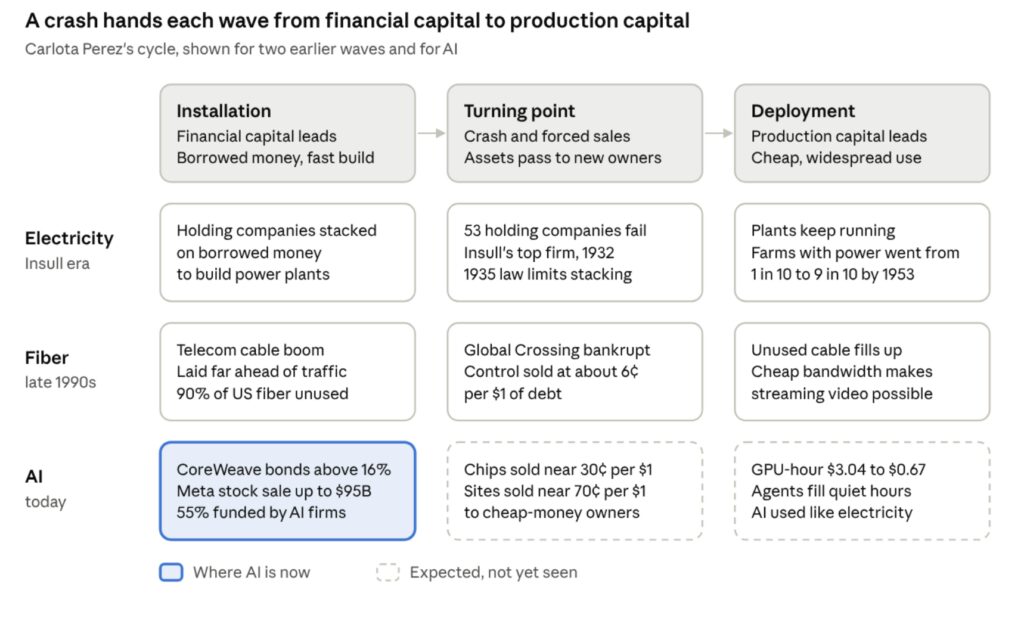
Electricity and fiber went through all three stages. AI is late in the first one, and the dashed boxes show what the rest of this article expects to happen next.
Railways and fiber went the same way
Britain built railways in a rush in the 1840s. In 1846 alone Parliament approved about 9,500 miles of new line. People really did use the railways and traffic grew, but the historian Andrew Odlyzko describes the period as a financial disaster for most of the investors who paid for it. About a third of the approved lines were never built. Britain still ended up with one of the most advanced rail networks of its time. The investors lost their money but the trains still ran on time.
Fiber optic cable followed the same path in the late 1990s. Telecom companies laid far more cable than the internet needed at the time, and by 2002 about 90 percent of US fiber was unused. Global Crossing had laid 160,000 km of cable across five continents and owed about $12 billion. When it went bankrupt, new owners took control in a deal worth about $750 million, roughly 6 cents for every dollar of debt. The cheap cable then made new businesses possible. Streaming video only works when moving huge amounts of data costs very little, and the unused fiber was eventually filled by companies that had paid nothing to build it. In both cases demand was real and the first owners still failed, which is the pattern the AI bond market is now pricing.
What lowers the cost
The new hotel owner did better for two reasons. She paid less for the building, and she borrowed more cheaply. Let’s study this closer..
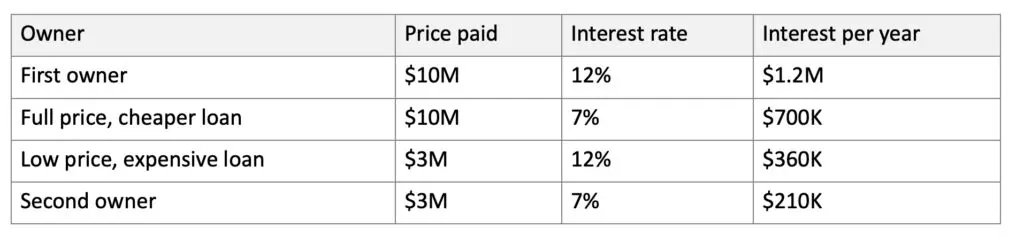
A cheaper loan can cut the bill from $1.2 million to $700,000. A lower price can cut it to $360,000. The lower price does more, and only a forced sale produces a price that low, because nobody sells a $10 million building for $3 million unless they have to.
There is a second way to lower the cost. The second owner pays $210,000 of interest a year whether her rooms are full or empty. Her hotel has 100 rooms, which is 36,500 room-nights a year. If she rents half of them, each rented room carries $11.51 of interest. If she rents 90 percent, each carries $6.39. The total bill is the same, but each room costs her about 45 percent less, so she can cut her prices and still make money. Lower prices bring in more guests, which fills the hotel further and lowers the cost per room again. That idea, keeping expensive equipment busy, is what turned electricity into a cheap utility.
How Samuel Insull made electricity cheap
Samuel Insull took over Chicago’s electric company in 1892, and he had the hotel owner’s problem from our example. He had to build enough generators for the busiest hour of the day, the early evening when everyone turned on their lights. For the rest of the day most of those generators sat idle, and he was paying for them anyway. He measured this with what he called the load factor, which is average use divided by peak use. A plant that could produce 100 units at its peak but averaged 30 over the day had a load factor of 30 percent, so most of its equipment was wasted most of the time.
His answer was to find customers who needed power during the day. He sold cheap daytime electricity to streetcar lines and ice houses, which kept the generators busy in hours when they would otherwise have been idle. His cost per unit fell, so he cut prices, and the lower prices brought in more customers. By 1897 his new pricing had cut many homeowners’ bills by about a third within a year. That cycle is how electricity became cheap.
Insull also ran a second business, which was how he raised money. To build power plants across many states, he stacked companies on top of each other. The companies at the bottom made and sold electricity. Above them sat holding companies that owned shares in the companies below and borrowed against those shares, and above those sat more holding companies doing the same thing. Every layer depended on the layer beneath it holding its value. After the 1929 crash the shares at the bottom fell and the loans stacked above them could no longer be covered, so the layers failed one after another. Fifty-three utility holding companies went bankrupt, and Insull’s top company failed in 1932.
The power plants kept running. Chicago’s electric company survived the collapse and is part of Exelon today. In 1935 Congress passed a law that allowed only one layer of holding company above the companies that made electricity and banned companies in the same group from selling to each other. A federal program created the same year lent money at low rates to bring power to farms. About one US farm in ten had electricity in the mid-1930s, and more than nine in ten had it by 1953. The cheap and universal electricity we know came from Insull’s idea about keeping equipment busy, combined with the rules written after his financial structure failed.
AI version of Insull’s money problem
The AI build-out has its own way of stacking companies, and it shows up in deals between suppliers and their customers. A chip company invests $10 billion in an AI lab, and the lab uses that money to buy $10 billion of chips from the same chip company. The chip company reports $10 billion in new sales, but no customer outside those two companies has paid for anything. The only real demand is whoever eventually rents the computing time from the lab.
If the lab gets into trouble, the chip company loses most of the value of its $10 billion investment, and the sales it was counting on stop at the same moment. In good times these deals make a supplier’s sales and its investments grow together, and in bad times they fall together.
The Bank for International Settlements, an organization owned by the world’s central banks, measured this pattern in October. Between 2021 and 2025, 55 percent of the money invested in AI companies came from other AI companies, and about 46 percent of that money also involved a buyer-seller relationship like the one above. The BIS also warns that many data centers are now financed through separate companies set up for a single project, with terms that are poorly disclosed. Lenders have started to charge for that uncertainty. Bonds tied to Meta’s Hyperion data center fell from above full value in July to about 92 cents on the dollar, and about $18 billion of loans tied to an Oracle project slipped into distress after delays in getting power permits.
Meta’s financing this month shows the same pattern at a much larger scale. Its spending on data centers and chips has overtaken the cash its business produces, so in October it began raising up to $95 billion by selling new shares, including a new class of shares that carry no votes. Nvidia, AMD and Broadcom, which sell Meta the equipment it is building with, have said they are interested in buying up to $5 billion of that stock, although none of them has committed. That is the chip company investing in its own customer, as in the example above. Meta is raising equity rather than borrowing, which makes it much harder to break than CoreWeave. If the spending disappoints, Meta’s shareholders absorb the loss and no lender can force a sale.
Some of these deals have good reasons behind them. When chips are scarce, a supplier that invests in its customer guarantees a buyer, and the customer guarantees its supply. Insull’s companies had a reason too, which was raising money faster than profits allowed. The danger shows up on the way down, and the 1935 ban on companies in the same group selling to each other was written to stop this pattern.
AI version of Insull’s daytime customers
A GPU, the chip that runs AI, works like one of Insull’s generators. Most of its cost is fixed, and the owner pays for it whether it runs or not. One 2026 analysis found that a GPU running at 10 percent of its capacity produces AI output at about ten times the cost of the same chip running flat out. Chatbots create the problem Insull had with evening lighting. People type during the workday and much less at night, so AI companies buy enough chips for the busy hours and leave many of them partly idle the rest of the time.
Meta’s Muse, launched in the US on September 8, uses chips differently. You give it a goal, such as booking a trip or finding a product, and it works on the task in the background, even after you close the app, coming back when it needs your approval. Work like that can be done in the quiet hours, so background agents could do for AI what streetcars and ice houses did for Insull. Meta also prices Muse the way a utility builds demand. There is a free version and two paid plans at $20 and $100 a month, and the company plans to earn money by taking a percentage of each purchase the agent makes.
Early adoption has been fast but partly paid for. Muse was downloaded 10.9 million times in its first 40 days and reached 2.5 million daily users on October 16. Seven days after installing it, 30 percent of new users were still using it, compared with 19 percent for the leading chat apps. Meta also put 39 percent of its advertising budget into promoting Muse in October. Meta has not said how background agents change how busy its chips are, so my claim here is a hypothesis. If agents move a large share of AI work into the hours when chips would otherwise sit idle, the cost of each task falls without any new hardware.
What keeps its value after a crash
Railways and fiber made good assets for second owners because they lasted for decades. Global Crossing’s new owners could wait most of a decade for internet traffic to grow into their cable. A data center is different, because it contains two kinds of assets with very different lives. The chips and servers are out of date in about three to five years. Used H100s, a common AI chip, sold for about $40,000 in late 2023 and now trade for roughly $6,000 to $35,000 depending on the model and condition. The building, the electrical equipment, the cooling and the connection to the power grid last 20 to 40 years, and they make up 30 to 50 percent of what a data center costs. If a failed company’s chips sit unsold for six years they are close to worthless, while the building with power still has value, and a large new grid connection can take years to get approved.
How long an asset lasts changes which kind of saving helps most. Each year the owner has to pay back part of the price plus interest. The table shows that yearly payment for an asset that costs $100.

On a five-year asset the owner pays back $20 of the price every year, so interest is the smaller part of each payment. On a 25-year asset only $4 of the price is paid back each year, so interest is most of the payment and a cheaper loan cuts the cost by much more. A lower purchase price therefore does the most for chips, while a lower interest rate does the most for the building. The owners who gain most from a cheap building are the ones who borrow most cheaply, such as regulated power utilities and infrastructure funds. The largest cloud companies used to belong on that list too. Meta, Alphabet and Amazon now spend more cash than they produce and are raising outside money, so after a crash they are less likely to have cash to spare for buying sites, and more of those sites will go to utilities and infrastructure funds.
Putting both savings together for a single GPU shows how far the cost could fall. The inputs are illustrative. The chips and servers cost $30,000 per GPU and last five years. The GPU’s share of the building and power equipment costs $15,000 and lasts 25 years. The first owner pays full price and borrows at 12 percent. The second owner pays 30 percent of the original price for chips with three years of life left and 70 percent for the building, and borrows at 7 percent.
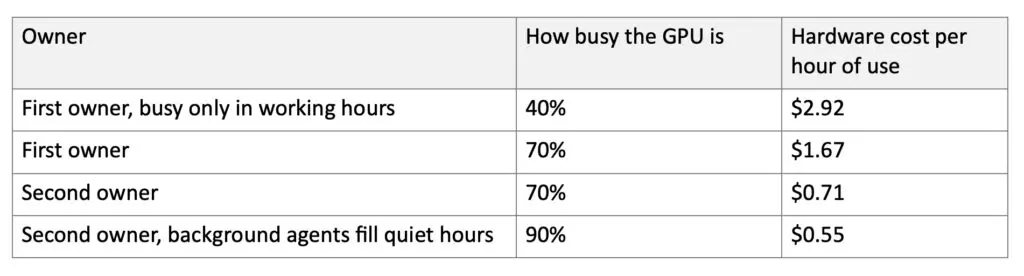
The hardware cost per hour falls by about four-fifths without any new technology. Once hardware is that cheap, electricity becomes a much bigger share of the cost. A GPU and its cooling draw about 1.5 kilowatts, so running it for one hour uses 1.5 kilowatt-hours. At 8 cents per kilowatt-hour that comes to 12 cents an hour, and both owners pay 12 cents.

For the first owner a cheaper power contract barely changes anything. For the second owner it can decide who wins on price. Take two second owners who both pay $0.55 an hour for hardware. One buys power at 4 cents per kilowatt-hour, which is 6 cents an hour and a total of $0.61. The other pays 12 cents per kilowatt-hour, which is 18 cents an hour and a total of $0.73. The first can sell about 16 percent more cheaply purely because of where it buys its power. Reliable power counts too, because a GPU earns nothing during an outage, and the second owner only reaches $0.55 by keeping her chips busy 90 percent of the time. After a crash, the price and reliability of electricity become one of the main things that separate a low-cost AI supplier from a high-cost one, which brings power companies into the story alongside chip makers.
Who makes money afterward
In earlier technology waves, the largest gains after the turning point went to the companies that reorganized an activity around the newly cheap input, more than to the companies that supplied it. Cheap electricity let factories put a motor on every machine instead of driving all of them from one central steam engine, and that made the moving assembly line possible. Cheap bandwidth after the fiber crash did the same for streaming video. For AI the equivalent change is delegation, where a person hands a task to an agent instead of doing each step through a website or an app.
Buying a $100 pair of running shoes shows where the money moves. The fee figures here are rough illustrations. Today you might see an Instagram ad, which the shoe brand pays Meta for, and then search on Google and click a sponsored link, which earns Google a dollar or two. If you buy through a marketplace like Amazon, it often keeps around 15 percent of the price. Between $15 and $20 of the $100 goes to companies that control the moment you decide. With an agent like Muse, you ask for good running shoes under $120 in your size, and the agent searches, compares and buys, possibly straight from the brand. It doesn’t click ads or scroll Instagram. Google loses the click and the marketplace may lose its fee. Meta’s own ad business loses too, and Meta takes a small cut of the purchase instead.
Meta is willing to eat into its own ad business because if it doesn’t build the agent, Google or OpenAI will, and Meta’s ads get skipped anyway. Cheap AI is also what makes this kind of business pay. If Meta earns $3 on the shoe purchase and the computing for the task costs $2 at today’s prices, very little is left. At the second owner’s cost of $0.67 an hour instead of $3.04, the same task costs about 45 cents, and the business works.
How this could turn out wrong
The first owners can avoid a forced sale if they refinance their debt more cheaply. CoreWeave has already signed an $8.5 billion loan at about 7 percent, reported as the first investment-grade loan backed by AI equipment. On chips, though, a cheaper loan alone lowers the cost by only about 12 to 16 percent, so refinancing helps most when demand rises at the same time.
Rising demand is the strongest escape. If customers keep the chips busy, the cost per hour falls without anyone selling at a loss, the way the first hotel owner could have survived with every room full. The catch is time. Fiber had a decade to wait for traffic, while chips have three to five years before newer models make them uncompetitive.
Prices could also stay high if AI capacity becomes scarce. Chips are unlikely to be the scarce part, because each new generation does more work for the money and pushes down what older chips can charge. Powered buildings are the likelier bottleneck. At least 47 large data center projects have been delayed, withdrawn or blocked in 2026, and more than 1,000 US communities have moved to restrict them. If scarcity keeps prices up, it will be because buildings with power are hard to get, which supports the argument that they are the asset that keeps its value.
If refinancing and growing demand are enough, there is no crash and no handoff. Perez calls that outcome a gilded age, where the original financial owners stay in charge and keep more of the gains while costs fall slowly. I expect the sharper version, because chips lose value too quickly to wait out a slow refinancing. Four things over the next two or three years would show which way it is going. When the first large chip-rental company is restructured, its buildings and grid connections should sell much closer to their original cost than the chips inside them.
The buyers should be utilities and infrastructure funds that borrow at single-digit interest rates. Reported chip use at the large AI clouds should rise as background agents grow. Regulators should also start requiring companies to disclose investments in their own customers after the first large default. If those things happen, the companies best placed to sell AI as a cheap, everyday utility will be the ones that own powered buildings and borrow cheaply on the day the original builders have to sell.
Sources
– Carlota Perez, The Social Shaping of Technological Revolutions research project
– Irving Wladawsky-Berger, summary of Perez’s What Is AI’s Place in History?
– John Thornhill, Financial Times, Brace for a crash before the golden age of AI (reprint)
– Andrew Odlyzko, Collective Hallucinations and Inefficient Markets: The British Railway Mania of the 1840s Railway Mania (overview)
– EC&M, Dark Fibers Lie in Wait
– Computerworld, Global Crossing sold in $750M deal, and Taipei Times, Global Crossing network details
– AJ Bell via Capital.com, AI capex boom risks
– Citybiz summarizing Bloomberg, OpenAI and Anthropic annualized revenue
– Gartner AI infrastructure impairment forecast
– Reuters summarized by Let’s Data Science, CoreWeave bonds and CDS
– IBTimes, AI debt issuance and the Firmus IPO
– Enterprise, Investors turn on the debt behind the AI build-out
– Samuel Insull and Brewminate, the emergence of electrical utilities
– SEC Historical Society, utility holding companies and PUHCA and PUHCA provisions
– John Wasik, Commonwealth Edison’s survival
– NRECA, history of rural electrification
– BIS Bulletin 137 summary, Universal Asset Owners brief on the bulletin, and BIS on SPVs and pledged assets– emma, H100 pricing and utilization economics
– Axios, Meta debuts Muse, TechRepublic, Muse launch details, eMarketer, Muse adoption and retention, Trefis, Muse monetization plan
– IntuitionLabs, Data center GPU pricing 2026
– Cleary Gottlieb, Financing the data center boom
– Epoch AI, LLM inference price trends
– Root Capital, CoreWeave debt structure
– Investing.com, Intel Q3 2026 results and outlook
– Let’s Data Science, Meta’s negative cash flow and $95 billion stock sale
– Yahoo Finance, Alphabet falls after hours as Google Cloud doubles
– Stock Titan, Amazon Q3 2026 results, and Microsoft results, October 28
Comments are closed.