
Helium moves up market – selling trust in connectivity to carriers (Analyst Angle)
Helium is moving beyond its crypto-hotspot origins, pitching carriers a combination of Wi-Fi offload and real-time network quality controls. The ambition is bigger: trusted connectivity across networks operators increasingly don’t own. Wi-Fi is the first test.
Helium no longer wants to be judged as a crypto hotspot network. Its new pitch to carriers is simpler and more ambitious: any network a carrier does not own, whether Wi-Fi, satellite direct-to-device, or IoT, can carry traffic on carrier terms, provided someone measures and controls it in real time. Helium wants to be that someone. The immediate opportunity is Wi-Fi, where existing infrastructure can address persistent indoor connectivity challenges for carriers, while providing a foundation for broader network management capabilities over time.
For years, the company was easy to categorize: a token-incentivized network of hotspots, first for IoT, then for Wi-Fi offload, with a consumer MVNO attached. That description no longer fits. Since Mario Di Dio became CEO of Nova Labs in June 2026, with co-founder Amir Haleem moving to chairman, Helium has sold its consumer business, refocused on enterprise B2B, and launched HeliumOS, a software suite for carriers, MVNOs, and venues. In our briefing, Di Dio argued that Helium’s key feature is no longer capacity alone. It is capacity carriers can trust.
From consumer brand to carrier supplier
Helium exited the consumer market in May 2026, selling its Helium Mobile MVNO to Noble Mobile, the carrier backed by Andrew Yang. The sale came with leadership changes and a single organizing focus: enterprise B2B.
Di Dio fits that focus. He joined Nova Labs in November 2022 as GM of Network, leading carrier partnerships, after roles at CableLabs and Kyrio. “I’m a telco guy, I’m not a crypto guy,” he told us.
Noble did not leave the fold. As soon as the deal closed, it became a customer of Helium’s MVNE platform. HeliumOS launched on September 1, and Di Dio describes the third quarter as pipeline building, with announcements of new carriers and venues expected in 2027.
Capacity and control: two businesses that feed each other
Di Dio frames Helium as two businesses in one. The first sells capacity. Helium aggregates Wi-Fi networks and sells offload to carriers. AT&T is its largest partner in the U.S., and Telefónica Movistar is its largest partner in Mexico, alongside smaller MVNOs and a joint venture with Mambo Wi-Fi in Brazil.
The second sells control. HeliumOS is the suite Helium now markets to carriers, MVNOs, and venues:
- WOX gateway (Wi-Fi Offload Experience): a real-time decision engine that steers users between Wi-Fi and cellular based on measured quality.
- Wi-Fi Toolkit: a Passpoint SDK that lets MVNOs and brands provision Wi-Fi access inside their apps.
- Helium AI: real-time queries and reporting on quality KPIs for any Wi-Fi network.
- MVNE platform: SIM, billing, and offload management for MVNOs, with Noble Mobile as the first public customer.
The important design choice is that HeliumOS is not limited to Helium’s own footprint, and over time it is not meant to be limited to Wi-Fi either. Rather than replacing its capacity business, HeliumOS builds on it, allowing the company to deliver both connectivity and the quality of controls carriers need to manage that connectivity at scale. A carrier that buys it can manage all of its Wi-Fi offload today, with the Helium Network serving as the proof point. Di Dio borrowed a line from his EVP of sales to sum up the pitch: “It’s irresponsible in 2026 to do a Wi-Fi offload strategy without control over the quality of experience.”
Wi-Fi first, not Wi-Fi only
Helium’s ambition is broader than Wi-Fi offload. Di Dio wants to sell trusted connectivity over any access network a carrier does not own. In his view, the icon at the top of a phone screen should not say LTE, 5G, Wi-Fi, or satellite. It should just say connected.
He described the journey he has in mind: a user drives down a remote highway on satellite direct-to-device, steps out of the car onto a macro cell, walks into a building and lands on Wi-Fi, and all of it feels like one seamless connection, even though the carrier does not own every asset serving that user. “The future is not verticalized,” he said. It is control over multiple networks.
Wi-Fi comes first because it is the low-hanging fruit:
- Indoor traffic. Di Dio cites Ericsson research showing that about 80% of mobile traffic is consumed indoors, and says Wi-Fi carries nearly all of it.
- Installed base. Enterprise Wi-Fi is already deployed in the venues carriers struggle to cover, and brownfield Passpoint onboarding turns it into carrier capacity without new hardware.
- Carrier pull. The retreat from carrier-funded DAS creates an immediate budget and an immediate problem to solve.
The next layers follow the same logic:
- Satellite direct-to-device. Di Dio said Helium talks to incumbents and newcomers alike, and that satellite players need the same seamless layer as everyone else. Satellite struggles indoors, which makes it a natural complement to in-building Wi-Fi rather than a competitor.
- IoT. Helium’s capacity business began with IoT before it moved to Wi-Fi offload. The same measure-and-control approach applies to IoT connectivity that carriers or enterprises rely on but do not own.
- Other access networks. Small cells, neutral host systems, and whatever comes next can feed the same quality stream, as long as they expose the metrics a carrier needs to steer traffic.
Today, HeliumOS is focused on making Wi-Fi connectivity more measurable, reliable, and manageable for carriers. Helium sees that capability as the foundation for eventually extending similar controls across additional access networks.
Tier 2 is where the battle is
Helium started as a Tier 3 play: coffee shops, restaurants, delis. Over the past ten months it has moved up market. Di Dio cited Bryant-Denny Stadium at the University of Alabama, BWI Airport, Hudson Yards in New York, and the Resorts World casino as venues now in the Helium ecosystem.
One driver is the changing economics of DAS deployments. As carriers reassess the cost of expanding or upgrading traditional indoor infrastructure, Wi-Fi offload offers an opportunity to supplement existing coverage and capacity without requiring comparable investments. For years, carriers funded distributed antenna systems with tens of millions in capex and hundreds of thousands of dollars a month in management fees. That spending is contracting. Di Dio put the cost gap bluntly: up to $6 per square foot for DAS, against about $0.25 for Wi-Fi.
He does not expect DAS to vanish from Tier 1 stadiums and airports, which carry strategic value, although Wi-Fi will play a critical role in capacity and redundancy. “The tier two is where the battle is,” he said: shopping malls, casino floors, hotel lobbies, conference centers, college campuses, school districts, and transit hubs. These venues concentrate enough users to matter but no longer justify carrier capex.
Two changes made the move possible:
- Brownfield onboarding. About two years ago, Helium built Passpoint integrations with other OEMs. Venues now configure existing enterprise Wi-Fi to join the network instead of relying on Helium hardware.
- Complement, not replace. Helium’s pitch is mostly supplementing DAS. Di Dio said a forthcoming Helium report shows DAS systems lose compatibility with new phone bands when not upgraded every two to three years.
Qualification is data-driven. Helium’s intake tracks DAS age, provider, host carrier, and any third-party operator. With venue permission, it runs cellular and Wi-Fi benchmarks to show carriers where to add capacity, terminal by terminal or sector by sector.
Di Dio also argued that offload is a revenue play, not only a cost saving. He cited an Ericsson ConsumerLab finding that 17% of 5G users switched providers over reliability, and said Helium has seen business lines move carriers because offload improved coverage at a venue.
Fixing Wi-Fi’s trust deficit
None of the technology underneath is new. Passpoint dates to 2012, and cable operators have deployed it across millions of access points. What failed was the control layer. Early carrier offload often delivered a poor experience, leaving what Di Dio calls “Passpoint PTSD” across the industry.
Helium’s answer is real-time quality metrics. It began this work three years ago within the WBA and the IETF, implemented it first on its own network, and is now working with major enterprise Wi-Fi OEMs. The metrics reach down to the access point: negotiated transmission rate, channel congestion, throughput, and backhaul quality.
The goal is a carrier NOC that shows Wi-Fi sites as blue dots beside red cellular sites, with the same drill-down KPIs. Eventually, Di Dio said, the same KPI stream should cover satellite direct-to-device, IoT, and other access networks, so a carrier can hand users from D2D to macro to in-building Wi-Fi seamlessly and optimize every hop with one set of metrics. He calls it “AWS for telco”: an opex model that keeps the trust carriers once got only from owning the stack.
Several positions stood out:
- Standards over secrecy. Unusually for a startup, Helium chose to invest in standardization. Carrier-grade offload, Di Dio argued, needs 3GPP-style minimum requirements that every OEM implements.
- OpenRoaming is complementary. He sees OpenRoaming as mainly a federation and settlement layer. Quality metrics sit deeper and can feed OpenRoaming or native Passpoint alike.
- Wi-Fi 6 is table stakes. For Tier 2 venues, Wi-Fi 6 is the practical baseline, with Wi-Fi 7 and 6 GHz where venues have upgraded.
- Control beats spectrum. Asked about GSMA arguments that Wi-Fi needs upgrades more than spectrum, he replied that more is not automatically better. Given the choice, he would “totally take the Wi-Fi 6 with control” over Wi-Fi 7 without it.
Brazil: the U.S. three to five years early
Di Dio sees Brazil as the clearest case for controlled offload, and possibly a better one than the U.S. Helium’s joint venture partner there, Mambo Wi-Fi, manages about 40,000 access points and built its business on captive portals and advertising.
His thesis rests on a squeeze. Radio equipment costs Brazilian carriers as much as U.S. carriers, or more after import costs. Data demand is climbing faster in a digital-first market. Yet ARPU is roughly a fifth of U.S. levels. The indoor coverage problem carriers face in the U.S. and Mexico is simply arriving faster.
That gives Brazilian carriers a chance to build offload with control from day one rather than retrofit it. “I see Brazil where the U.S. will be in three to five years,” Di Dio said. A launch event in São Paulo planned for December has been pushed into 2027, to coincide with an announcement.
The business model and the numbers
Currently, Helium runs two pricing models. Capacity is sold per gigabyte. Di Dio gave a range of roughly $0.05 to $0.50 per GB, depending on venue tier, geography, and whether the buyer is an MNO or an MVNO. MVNOs, which buy wholesale capacity themselves, typically pay more. For context, the carrier payer rate was cut from $0.50 to about $0.10 per GB in June 2026, underpricing authority HIP-143 established . Helium continues to adapt, in line with their partners, the appropriate pricing model for this new Wi-Fi based service enablement stack.
Most or all of that capacity revenue passes through to the venue, or to the managed service provider when the MSP funded the Wi-Fi. Large Tier 1 and Tier 2 venues usually take payment in U.S. dollars, while Tier 3 venues are more open to crypto. Monthly earnings for the biggest venues run into the thousands of dollars, depending heavily on how much the existing DAS needs supplementing.
HeliumOS is priced as SaaS: per user per month for the MVNE platform, and per optimized user for the WOX gateway. As a private company, Helium would not forecast revenue. Di Dio said software and offload revenue are currently of a similar order of magnitude, and that double-digit millions in ARR are “within reach” in the current pipeline.
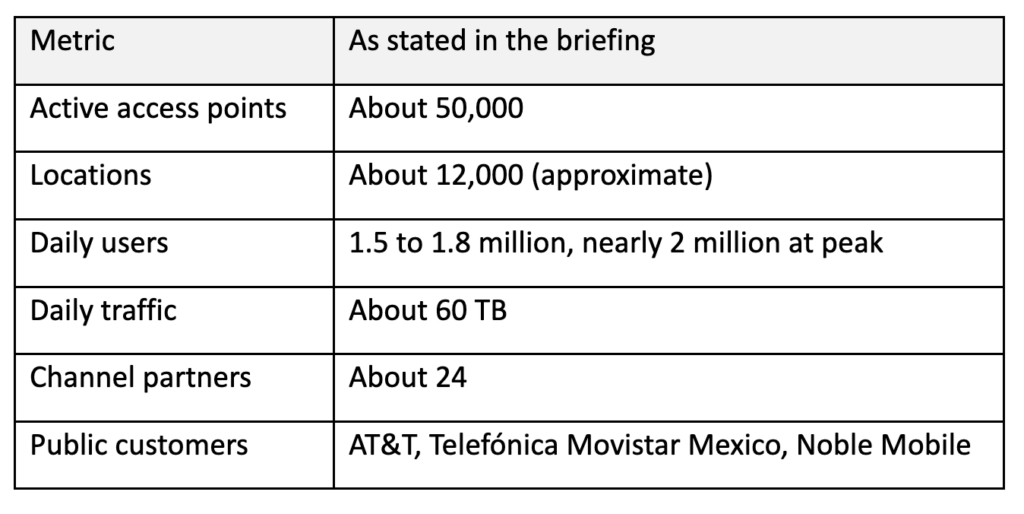
The access point count deserves a note. Light Reading reported about 141,000 Wi-Fi access points in September 2026, of which roughly 40,000 were actively carrying traffic. Helium now reports active access points only, and plans to add location counts. That is the more honest metric, and the one investors should track.
The crypto question
Di Dio insists the token is not a sales obstacle, because buyers never touch it. Carriers sign dollar-based contracts and carry no crypto assets on their balance sheets. Venues can be paid in dollars. Asked whether the token has cost Helium a deal, he answered no.
So why keep it? “Crypto allows us to grow,” he said. Helium relies on about two dozen channel partners that find and bring in venues, in effect a distributed sales force outside its payroll. Many are crypto-native firms that have grown from one or two people into teams of dozens. The token gives them skin in the game, and venue acquisition accelerates when the token market rises.
Governance has shifted in the same direction as the business. HIP 149 retired Proof of Coverage, now pays deployers only on real carrier traffic, and funds operations with about 141 million HNT over 36 months under an elected advisory council. The open question is whether the channel engine stays productive when token prices fall.
MSPs, neutral hosts, and the measurement layer
The ecosystem around Helium is shifting too, and three groups matter:
- Managed service providers. Some of Helium’s channel partners are MSPs that run Wi-Fi on behalf of venues. Who keeps the offload earnings depends on who paid for the Wi-Fi. When the MSP funds the capex, it usually keeps most of the earnings and shares a percentage with the venue. When the venue owns the network, most earnings go to the venue.
- Neutral hosts. Helium has nothing to announce with Boldyn or Boingo, both long-time DAS players that also run Passpoint. Di Dio said conversations with DAS providers have multiplied in recent quarters, and he would not be surprised by joint sales strategies.
- Measurement firms. Ookla and Opensignal are rolling out venue certification programs. Di Dio sees a role for them in validating multi-network venues and closing the loop after deployment.
For multifamily and other MSP-served properties, the MSP model is the one to watch. Offload revenue becomes an additional line on a network the MSP already operates.
The Maravedis take
Separating the control layer from its own network is the right call. If HeliumOS can manage any carrier’s Wi-Fi, Helium stops competing as one more offload footprint and starts offering carriers both capacity and the tool every footprint needs. If it can then extend that control to satellite D2D, IoT, and other networks, it becomes the multi-network trust layer carriers will need as they stop owning every asset that serves their subscribers. Starting with Wi-Fi is the right sequencing: carriers are pulling back from DAS just as Wi-Fi 6 and Wi-Fi 7 make indoor Wi-Fi credible.
Five questions will decide whether the pitch converts into scale:
- Carrier trust and DAS contract tails. Passpoint scar tissue is real, and many venues sit inside DAS agreements lasting ten years or more. The complement story helps, but adoption will be gradual.
- Customer concentration. AT&T is the anchor in the U.S. T-Mobile offload via Ameriband ended on August 31, 2026, after carrying about 47% of rewardable Helium Mobile traffic. That did not come up in our briefing, and replacing that volume matters.
- Standards as a double-edged sword. Helium is pushing the industry toward common quality metrics. If 3GPP and the WBA standardize them, differentiation shifts to execution, integrations, and the installed base.
- Metrics investors can verify. Di Dio is openly courting TMT investors. Revenue alone will not tell the story. Offloaded terabytes, paying carriers and MVNOs, active sites by vertical, software ARR, and a credible TAM and SAM for Tier 2 venue offload will. Few analysts track that market today.
- Proof beyond Wi-Fi. Today every HeliumOS product, from the WOX gateway to the Wi-Fi Toolkit, is Wi-Fi specific. The any-network story needs a first non-Wi-Fi reference, such as a D2D operator or an IoT customer using the same control layer, before it moves from vision to pipeline.
The bottom line: Helium is betting that carriers need more than capacity from networks they do not own: they need capacity they can see, control, and rely on. Delivering both from one supplier is what could make Helium a connectivity partner to carriers rather than one more software vendor. Wi-Fi is the first test. If Helium can make Wi-Fi capacity measurable and reliable on carrier terms, it earns the right to do the same for satellite, IoT, and whatever comes next, and the crypto origins will matter far less than the combination of capacity and control it built.
Maravedis is an independent research firm. This profile was not sponsored, and Helium had no editorial control over its content.
Table of Contents
Comments are closed.